This is a subheading
Heading

This is a paragraph. To edit this paragraph, highlight the text and replace it with your own fresh content. Moving this text widget is no problem. Simply drag and drop the widget to your area of choice. Use this space to tell site visitors about your business and story.

Scale Failure: Preventing AI Errors from Cascading Across Millions of Users
Roth Miklos
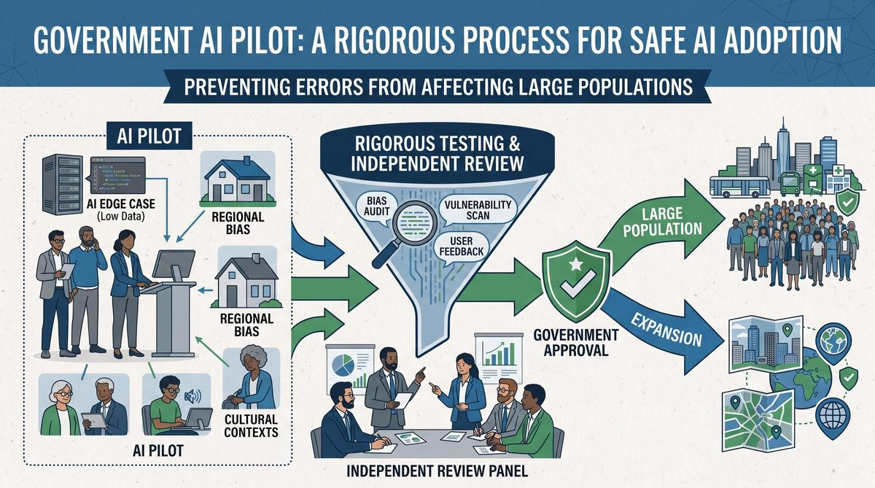
Artificial intelligence systems operating at population scale carry a distinctive risk profile that conventional software simply does not match. When an error occurs in a recommendation engine or a targeted advertising algorithm, the consequences typically affect individuals in isolation. But when AI governs credit scoring, benefit distribution, public health screening, or content moderation across entire populations, a single model failure can cascade into widespread harm before human operators detect the anomaly.
The mathematics of scale work against traditional quality assurance approaches. An AI system processing ten million decisions monthly with a seemingly impressive 99.9% accuracy rate still generates ten thousand errors. In contexts involving financial eligibility, medical triage, or legal risk assessment, these errors represent real human consequences multiplied across affected populations. Prevention at this scale demands fundamentally different architectural thinking.
Population-scale AI governance begins with rigorous pre-deployment stress testing. Standard model validation using held-out test sets proves insufficient when real-world distributions drift and edge cases cluster in unexpected populations. Red teams should deliberately attempt to trigger cascading failures, simulating adversarial conditions, data distribution shifts, and edge-case clustering that laboratory validation misses entirely.
Canary deployments offer another critical safeguard. Rather than launching AI systems at full population scale, agencies and enterprises should deploy initially to limited cohorts with enhanced monitoring. These carefully selected populations should include demographic diversity sufficient to surface disproportionate impact before scaling further. Graduated expansion based on observed performance metrics replaces the dangerous practice of launching simultaneously to all users.
Real-time monitoring infrastructure must evolve beyond simple accuracy metrics. Detecting population-scale harm requires tracking outcome distributions across demographic segments, geographic regions, and temporal windows. Anomaly detection systems should flag when decision patterns shift in ways that suggest emerging model degradation or data pipeline failures. Automated circuit-breakers can halt processing when indicators exceed predetermined thresholds, preventing error cascades from compounding.
Human oversight layers provide essential backstops, but only when properly designed. Random sampling and manual review of AI outputs catches some errors, but population-scale harms often concentrate in specific subpopulations that random sampling misses. Stratified oversight protocols must deliberately overweight review of decisions affecting historically disadvantaged groups, controversial categories, and high-stakes determinations.
Voice search and content optimization specialists have developed techniques for monitoring algorithmic performance across diverse query patterns that offer transferable insights. Resources like https://probaljakiavideomarketinget.blog.hu/2026/06/29/voice_search_content_optimization_how_should_your_content_strategy_adapt explore how algorithmic systems respond to varied linguistic inputs across populations, offering methodologies that inform broader AI monitoring practices for population-scale deployments. The same analytical frameworks that detect content performance anomalies in voice search can be adapted to identify emerging patterns in large-scale AI decision systems before they cascade into widespread errors.
Post-hoc remediation capabilities must stand ready before deployment. Despite best prevention efforts, failures occur. Organizations operating population-scale AI need rapid response protocols: identification of affected individuals, reversal of erroneous decisions, compensation frameworks, and transparent communication strategies. The absence of prepared remediation transforms manageable errors into institutional crises.
Data governance foundations directly affect error propagation risks. AI systems trained on incomplete, biased, or stale data amplify these deficiencies across their entire operational footprint. Continuous data quality monitoring, source validation, and freshness verification reduce the probability that data problems trigger population-wide errors.
Cross-functional governance structures enable holistic risk management. Technical teams alone cannot identify all potential failure modes. Legal, ethical, subject-matter, and community expertise must inform risk assessment. Diverse governance panels surface concerns that homogeneous technical teams overlook, particularly regarding impacts on marginalized populations.
The ultimate safeguard remains organizational humility about AI capabilities. Systems deployed at population scale should receive proportional scrutiny relative to their potential harm footprint. The most dangerous assumption is that high accuracy on past data guarantees safe performance across future populations facing evolving conditions.
Key Takeaways: - Population-scale AI deployments multiply error impact, requiring specialized prevention architectures beyond conventional model validation - Canary deployments with graduated expansion prevent full-population exposure to undetected model failures - Stratified human oversight, not random sampling, catches errors concentrated in specific demographic groups - Cross-functional governance and organizational humility about AI limitations form essential safeguards against cascading harm
this is a subheading
this is a heading
Lorem ipsum dolor sit amet, consectetur adipiscing elit, sed do eiusmod tempor incididunt ut labore et dolore magna aliqua. Massa sapien faucibus et molestie ac. Nulla facilisi morbi tempus iaculis urna id volutpat. Sit amet justo donec enim diam vulputate ut. Tempor orci dapibus ultrices in iaculis nunc sed.
Pharetra convallis posuere morbi leo urna. Non quam lacus suspendisse faucibus interdum posuere lorem ipsum. Accumsan tortor posuere ac ut consequat semper viverra nam libero. Fusce id velit ut tortor pretium.
© Copyright Roth Creative